Tread Carefully: The Lease-Return Tyre Bill You Can Still Avoid
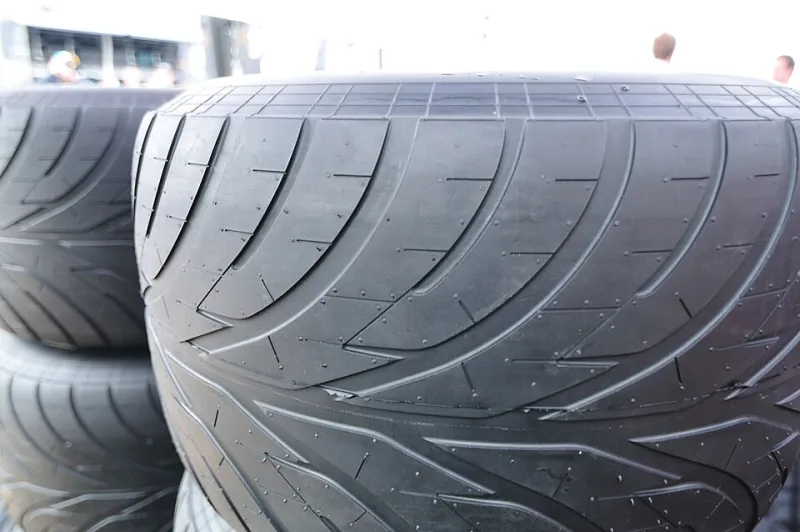
Photo: Gregory Moine, CC BY 2.0, via Wikimedia Commons
Most drivers worry about kerbed alloys and shopping-trolley dents when handback looms. In practice, it's usually the four bits of black rubber on the corners that generate the invoice. A lease return tyre charge can easily run to several hundred pounds, and the frustrating part is that a good chunk of it is avoidable if you know what the contract actually asks for — and what it doesn't.
This isn't about dodging your obligations. It's about making sure you pay retail prices for tyres you genuinely needed, rather than inspector prices for ones you could have sorted yourself six weeks earlier.
Legal minimum is not the lease minimum
The first thing to get straight: the law and your contract are two different documents.
Legally, a car tyre needs 1.6mm of tread across the central three-quarters of its width, all the way round. Below that you're looking at three penalty points and a fine per tyre. That's the roadworthiness line.
Contract hire agreements typically sit well above it. Most leasing companies work to the BVRLA Fair Wear and Tear Standard, which says tyres must be returned in a legal and roadworthy condition — but many funders add their own margin, often expecting tread around 2mm to 3mm at handback, and some penalise visible uneven wear even when the average depth is fine. Read your agreement's return section properly. The number you're looking for is usually in a schedule or an appendix, not the headline terms.
If your tyres are at 2.5mm, you're legal but potentially in scope for a recharge depending on your funder. If they're at 4mm and evenly worn, you're fine and can stop worrying.
The matched-pair rule nobody mentions on the phone
Here's where people get caught. You replaced one front tyre at a kwik-fit-style chain eighteen months ago with a budget brand. The other front is still the original factory fit. Both are legal, both are roadworthy — and the inspector flags the axle as mismatched.
Many lease contracts require tyres to be matched on the same axle: same size, same speed rating, same load index, and often the same brand and tread pattern. Some are stricter and want all four consistent. It's rarely spelled out at the point of sale, which is why it's the most common surprise charge in the return report.
The practical fix is simple. If a tyre needs replacing during the lease, replace it in pairs on that axle, and try to match what's already there. If you're within a year of handback, it's often cheaper to buy a part-worn or mid-range matching tyre than to accept a recharge for the mismatch later. Check the sidewall markings before you buy: something like 205/55 R16 91V tells you width, profile, rim, load index and speed rating. All of those need to line up.
Run-flats, EV tyres and other specification traps
Two categories deserve particular care.
Run-flats. If the car came with run-flat tyres, you generally have to return it on run-flats. Fitting conventional tyres is cheaper and tempting, but it's a specification breach and inspectors know exactly what to look for. The same applies to any reinforced sidewall marking — check for an 'RFT', 'SSR', 'RSC' or similar code on the original sidewall before you substitute anything.
EV-specific tyres. Electric cars often run tyres with a higher load rating, lower rolling resistance compound and acoustic foam inside. The sidewall may carry an 'EV' marking or a manufacturer-specific code such as 'T0' or 'AO'. If your lease is on a Tesla, a Kia EV6 or a Vauxhall Mokka Electric, don't assume a standard tyre of the same size will pass. It might — but confirm it with the funder in writing rather than finding out at inspection.
Inspect and document before you hand the keys over
Give yourself a proper tyre audit about six to eight weeks before the return date. That's enough time to source replacements without paying premium rush prices, and early enough that you're not making panicked decisions in the last week.
Work through this in order:
- Measure tread across each tyre at three points — inner, centre and outer — using a proper gauge rather than a 20p coin. Uneven readings suggest alignment or suspension issues, which you'll want to fix before they scrub a new set.
- Check the sidewalls for cuts, bulges, kerb scuffs and embedded objects. A bulge is an automatic fail and a safety issue, so replace it regardless.
- Note the brand, size and markings on all four and compare them axle by axle.
- Photograph everything, including a shot with a tread gauge in place and a dated image of the sidewall markings. If there's a dispute later, this is your evidence.
- Get the wheel alignment checked if wear is uneven. A £60 alignment now can save a pair of tyres.
Buying your way out of the invoice
If a replacement is needed, you have three routes.
Retail replacement before return. Usually the cheapest. A mid-range tyre from a reputable independent is typically £70–£140 fitted depending on size, versus a recharge invoice that may bill you £150–£250 per tyre for the convenience. Match the specification and keep the invoice.
Ask the funder to quote. Some leasing companies will offer to handle replacements at a fixed rate if you flag it early. Occasionally this is competitive; often it isn't. Get the number in writing either way.
Accept the recharge. Perfectly reasonable if the tyre is genuinely worn out and you're near the end of the term. Just make sure the charge reflects fair wear and tear, not a speculative mark-up. The BVRLA standard is your reference point, and funders who are members are expected to work to it.
The bottom line
Tyres are a consumable, and nobody expects you to return a lease car on factory-fresh rubber. What funders do expect is that the tyres are legal, roadworthy, correctly specified and reasonably matched. Get those four things right, keep photographs and receipts, and the tyre line on your return report should be a short one.
Spend an hour with a tread gauge eight weeks out, and you'll probably spend a good deal less than the driver who leaves it to the inspector.